Why is YouTube making subtitles worse and worse?
Over the years, YouTube has been making changes to subtitles which have made them worse and worse. Now I know that not everyone watches videos with subtitles turned on, but... I do. You know who else does? The hearing impaired, which is about ~20% of the world. According to the Global Burden of Disease's 2019 study, ~15% of the world has a mild hearing loss, and ~0.15% of the world is completely deaf. Or 12.6 million. And just generally a lot of people appreciate having text on screen.
I am a firm believer in making tech accessible to everyone. I mean, who wouldn't be? Anyway, not to talk about myself, lets talk about the good old closed captions that not just the hard of hearing appreciate. These are some blunders (in my opinion) YouTube has done, and what I think about them. Spoiler: I don't really like any of them.
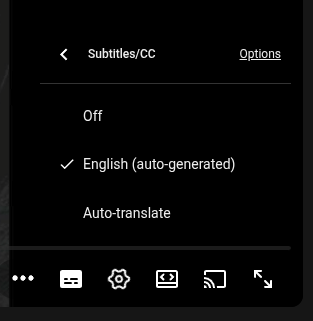 YouTube subtitle settings, showing English (auto-generated) selected
Blunder 1: Discontinuation of Community Subtitles
On September 28, 2020 (wow almost exactly 6 years ago) YouTube put the kibosh on viewers submitting closed captions, subtitles, and translations; including for titles and descriptions. Creators could review and approve submissions (since August 2019), or previously, they could auto publish after enough community reviews. That "community review to publish" thing is kinda akin to how Community Notes/Birdwatch works on Twitter, one person writes this, the surrounding community reviews it, and if it gets enough approvals, it goes live for everyone.
Cool system, right? Well yeah, sounds like an amazing system. Well, YouTube didn't agree. They stated, in the shutdown, that the system had "very low usage", fewer than 0.001% of channels had published any community captions, and of course, spam, abuse, and low-quality submissions.
I'm not really convinced by either of those.
Low usage of an accessibility feature is usually a design and promotion failure, not proof the feature should be deleted. YouTube Music and YouTube Kids also reach far smaller audiences than the main platform - yet no one is seriously arguing those should be shut down. Community captions served a real (if smaller) audience: deaf and hard-of-hearing viewers, language learners, and creators who couldn't afford professional captioning.
As for spam and abuse: almost every open system on YouTube is vulnerable to it, like comments! Comments, which don't (usually) need creator or community approval, they can just appear instantly. And with the addition of creator approval in 2019, YouTube was clearly cognizant of abuse, but they still canned it a year later. It doesn't make much sense.
I have a personal stake in this. One of my hobbies is writing detailed captions (the proper TTML kind with colour, positioning, the works). Since community contributions disappeared, the only way to offer that work is to cold-email creators and hope they respond. I've reached out to several - Fidias, MegaLag, Vevo, STMPD RCRDS among them - and heard nothing back. That's not surprising, but it illustrates the real cost of the change: what used to be a built-in, low-friction way for the community to improve accessibility is now dependent on creators noticing and trusting a stranger's email. Most won't. So fewer good captions get made. And that's just bad.
Blunder 2: Omitting or censoring profanity
Historically, YouTube has always been seen as a place where you won't get utterly nuked for using profanity, unlike somewhere like TikTok. Creators have long been able to swear freely in their videos without the platform automatically punishing them for it.
Now, I know there used to be some insane 7 second rule which would affect monetization, but they removed that in 2025. So it would truly seem like anything goes in terms of mild profanity.
Well, nah. As far as I can remember, auto subtitles replace profanity with [__]. And that's annoying, sure, but you could still probably figure out what was said. Like, if whats said is:
"I'll fucking break that shit", and it becomes "I'll [__] break that [__]", you could probably still deduce what was said. But recently, I've noticed that auto subtitles completely omit profanity, which is tenfold worse.
I acknowledge a sentence can still make sense without intensifiers like "fucking", but profanity could be the very crux of some sentences, and without it, it becomes nonsensical. Like "you fucking bitch" could become "you". Just "you". It loses all meaning.
If this was coming from a platform more anti-profanity I would understand, but it feels pretty contradictory to allow profanity but also not allow profanity in captions, don't you think?
Blunder 3: Revamping the transcript viewer for the worse
Circa early 2026, I started noticing a new transcript viewer. This is how the old one looked:
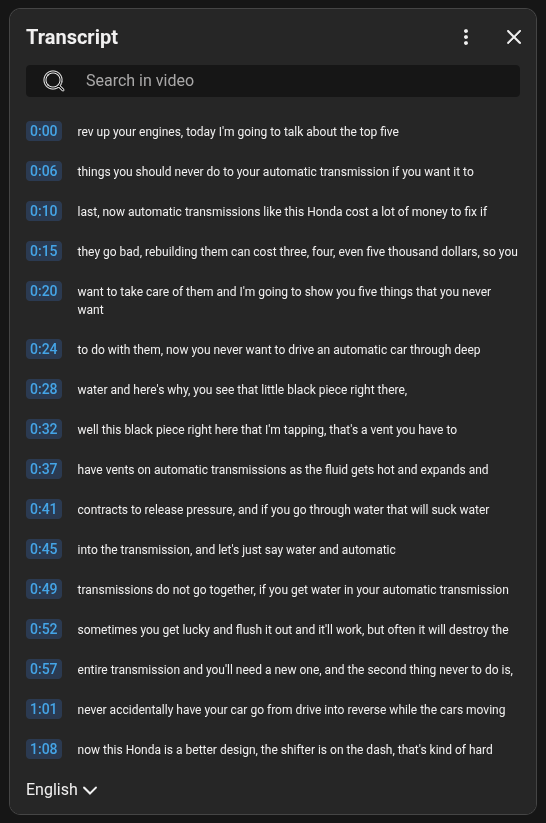 The old transcript panel on YouTube on a Scotty Kilmer video
Pretty utilitarian. A language switcher down the bottom. Clicking the three-dotted-menu would show a toggle to show timestamps. It showed each line pretty cleanly. And here is the new one:
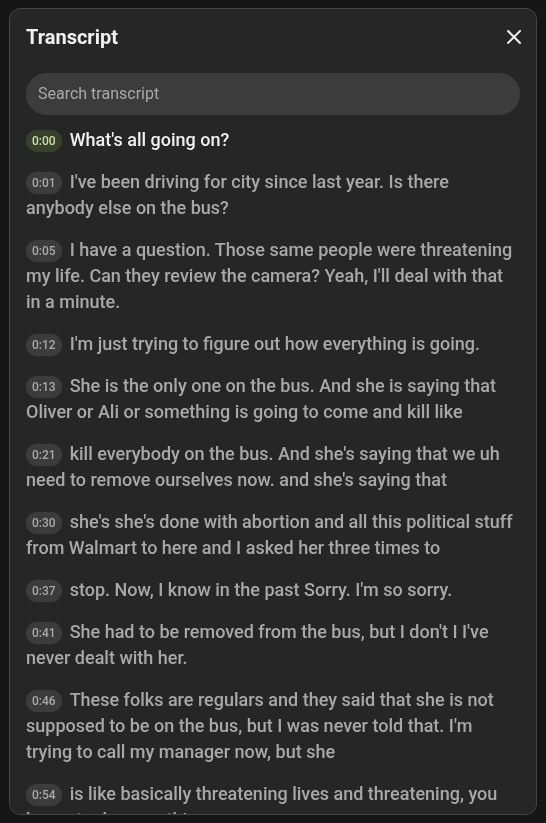 The new transcript panel on YouTube on a Midwest Safety video
Visually, this is already so much worse. There's no language switcher, nor a show timestamp toggle. The lines have been aggregated into, I dunno, two lines? And clicking a line doesn't even go to the precise time anymore. If it's marked 0:21, it will go exactly to 0:21.000. Unlike the previous one, which would jump to where the line begins, despite the plain timestamp.
I know I'm nerding out over something pretty minor, but this is craziness. There was no reason to change this. In 2023, YouTube moved the entry point from the 3 dotted menu (in the same row as like/dislike/share) to the bottom of the expanded video description. That made the feature harder to discover. Now they've taken a functional panel and made it less precise and less useful. There was no clear problem that needed solving here!
Conclusion, in a nutshell
Over the last six years YouTube has steadily made subtitles and transcripts worse for the people who actually rely on them.
They killed community captions in 2020 - a system that let viewers add subtitles and translations - because of "low usage" and spam, even though the feature already required creator approval. They left us with automatic captions that regularly censor or drop profanity, creating an odd double standard where the audio is allowed to say something the text is not. And in 2026 they replaced a functional transcript panel with a less precise, less useful version that removes basic controls and breaks accurate seeking. None of these changes were forced by technical limitations. They were product decisions that traded accessibility, accuracy, and usability for simplicity or just change for its own sake.
Subtitles are not a nice-to-have. For millions of people they are how the video is understood. When a platform keeps making that layer worse, it is not a neutral design choice.
That's really about it! See ya.